English
Español
Welcome to the Island!

Isla Mujeres, México

English
/
Español
Welcome to the Island!

Isla Mujeres, México

CARING FOR OUR ENVIRONMENT

SIMPLY: RESPECT

Every day we are so happy to interact with the natural world that surrounds us on this island. It is sometimes a challenge to make sure we are contributing to a balanced relationship, and that we not only enjoy, but also care for and give back to our environment. It is natural that so many of us find it so healthy and liberating to swim in these beautiful waters, but it doesn’t come without a cost and consequences to the ecosystem, and it is always so much greater to come out of these experiences with a little more consciousness and knowledge. For example….(?) – DID YOU KNOW – (?) that the natural skin oil on our hands can promote fungi growth on corals if contact is made? This is one reason why it’s very important not to touch them. Corals are years and years old…and yet so easily damaged. This is just a single tiny example of a bit of knowledge that can help us be better and help our home. We become powerful when we show respect.

TOGETHER: OUR HELP FOR NATURE MATTERS

Showing respect in the integration with our natural world is so crucial…we eat from it, we breathe from it, we learn through it, we feel from it. It truly is in our best interest to provide the best care possible. To serve it!… not just take from it.
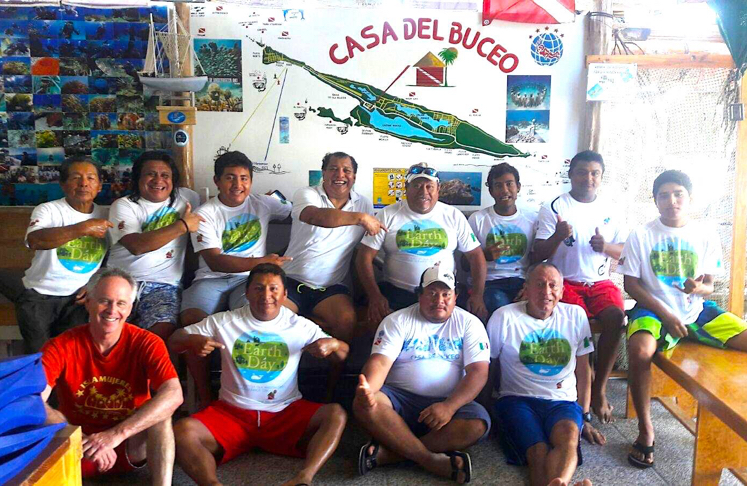
All the animals feel, corals feel, plants feel…. this is essential. Why would we want to cause them pain in any way? At Casa del Buceo we are not the wisest and sometimes a lack of financial resources can hinder our ability to have more advanced solutions, but we really do make efforts in the ways we can, in order to cause as little damage as possible to the wonderful world that surrounds us. Whenever we can, we go an extra little bit.
Come visit us and feel free to ask us anytime about our initiatives and the ways in which we contribute our grains of sand. But most importantly – tell us YOUR IDEAS! for more respectful, sustainable practices! If there is anything you can share or suggest to help us become more educated or efficient towards our surroundings, PLEASE! contact us! We, humans, are not helpless…we have all the power to help nature! There is ALWAYS something we can do. Right?? YOU can always help. TOGETHER, WE CAN ALWAYS HELP.
In the video below, Pablo touches on the importance of MUSA (the Underwater Sculpture Museum). You can also read more on this initiative [here]

COMMUNITY
PARTICIPATION

Lorem ipsum dolor
Lorem ipsum dolor sit amet, consectetur adipiscing elit. Praesent bibendum aliquam nisi, sed molestie mauris tincidunt non. Donec semper pulvinar libero eget congue. Integer dui urna, tristique at sem vestibulum, feugiat dictum risus. Nulla tincidunt efficitur laoreet. Morbi lobortis tempus metus, ac tristique lectus rutrum vel. In luctus volutpat consectetur.

Lorem ipsum dolor
Lorem ipsum dolor sit amet, consectetur adipiscing elit. Praesent bibendum aliquam nisi, sed molestie mauris tincidunt non. Donec semper pulvinar libero eget congue. Integer dui urna, tristique at sem vestibulum, feugiat dictum risus. Nulla tincidunt efficitur laoreet. Morbi lobortis tempus metus, ac tristique lectus rutrum vel. In luctus volutpat consectetur.
Lorem ipsum dolor
Lorem ipsum dolor sit amet, consectetur adipiscing elit. Praesent bibendum aliquam nisi, sed molestie mauris tincidunt non. Donec semper pulvinar libero eget congue. Integer dui urna, tristique at sem vestibulum, feugiat dictum risus. Nulla tincidunt efficitur laoreet. Morbi lobortis tempus metus, ac tristique lectus rutrum vel. In luctus volutpat consectetur.


MUSA [Underwater Sculpture Museum]

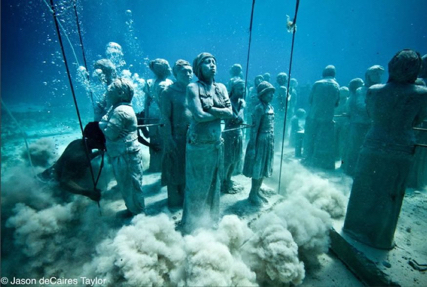
MUSA is an innovative project designed to counteract the effects of climate change on our oceans and reef systems. This museum is a work-in-progress and located just off the coast of Isla Mujeres. It was formally opened to the public on November 26, 2010 and will ultimately consist of 12 galleries containing nearly 1,364 artificial habitats. The aim is to discharge the accumulated impact of nearly 800,000 visiting tourists each year in the natural reef of the National Marine Park, while increasing overall biomass of the reef system and habitat areas for marine life to colonize. The project was initiated by Dr. Jaime Gonzalez Cano, local head of Mexico’s Environment and Natural Resources Secretariat (SEMARNAT). Looking for a way to ease the stress on the local reef system without having to close the national underwater park, Dr. Cano reached out to the British sculptor, Jason deCaires Taylor, to collaborate and build one of the largest and most ambitious underwater artificial art attractions in the world. The project became a reality with the collaboration of both the Cancun and Isla Mujeres’ Nautical Associations and other private sector supporters. (musaislamujeres.com)

Excerpts from The Guardian article "Silent Evolution in Cancún, Mexico"
By GrrlScientist

Hypothesis: creating an underwater sculpture will relieve tourist pressure on nearby coral reefs whilst providing new habitat that encourages establishment of yet more coral reefs.

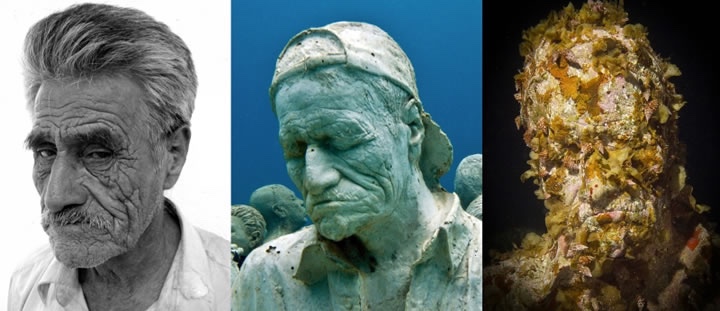
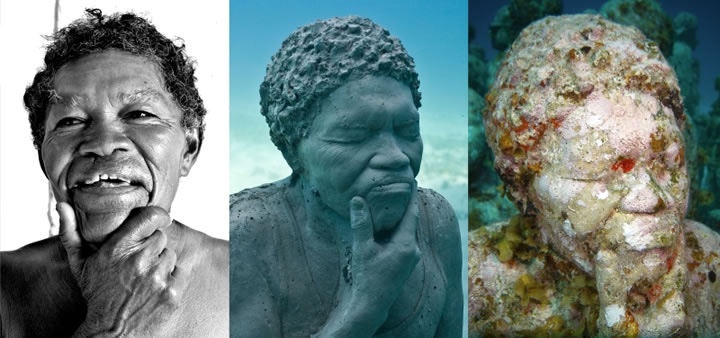
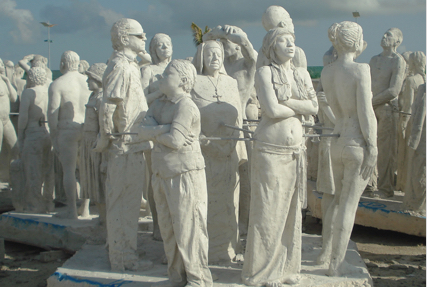
British artist and sculptor, Jason de Caires Taylor, has created a huge underwater sculpture, “The Silent Evolution”. This sculpture weighs over 120 tons and is comprised of 400 individual statues cast from local Mexican people, representing a cross section of society.

The goals of this sculpture are twofold: first, (it) is easily accessible to snorkelers and divers so it will ease pressures on the nearby natural reefs that are visited by 750,000 tourists every year. Second, this installation will provide the basis for a coral reef-like ecosystem that will attract a variety of aquatic creatures to the Cancún and Isla Mujeres National Marine Park. It is made from a special cement that is 10 times harder than the normal kind and it has a neutral PH (favourable to corals), and the statues are anchored to a barren rocky seabed 10 meters below the water’s surface.
Coral reefs are constructed of calcium carbonate secreted by the bodies of countless numbers of tiny marine animals. Often known as the “rainforests of the sea”, coral reefs form some of the most diverse ecosystems on earth. They are surrounded by nutrient-poor ocean waters, yet they provide food and shelter for roughly 25 percent of all marine animal species, including fish, molluscs, worms, crustaceans, echinoderms, sponges, tunicates and other cnidarians.

The coral reefs that most people are familiar with are found in shallow tropical waters, but they can be found in cold or deep water as well. Even though coral reefs occupy less than one tenth of one percent of the world’s ocean surface (roughly the same area as Norway), they are one of the most endangered marine ecosystems in the world. Currently, 10 percent of the world’s coral reefs are already dead and another 60 percent are at risk due to destructive, human-related activities, including ocean acidification and increasing water temperatures due to global warming, as well as agricultural and urban runoff, pollution, overfishing and a variety of other threats.

More sculpture displays that can be seen during our tours off of Isla Mujeres include:

“Seascape”, “The Dream Collector”, “Time Bombs”, “Man on Fire”, “The Banker”, “Anthropocene” and “Urban Reef House”.

Images from www.musaislamujeres.com
By Jason deCaires Taylor. Images from www.musaislamujeres.com